

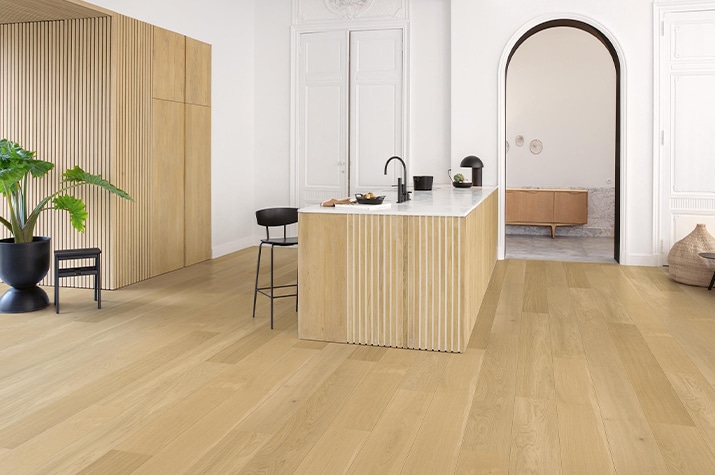
In the architectural landscape of Sydney’s Inner West, the heritage terrace represents both a triumph of Victorian design and a significant challenge for modern flooring professionals. When homeowners seek the warmth of natural wood, locally manufactured engineered timber has emerged as the premier specification for these narrow, historically sensitive structures. This material is not merely an aesthetic choice; it is a sophisticated solution to the dimensional instability inherent in Sydney’s humid coastal climate and the shifting foundations of century-old buildings.
However, the success of a premium floor in a Stanmore residence is rarely about the timber itself. Instead, it is a direct result of the rigorous technical protocols followed during the installation process. In this guide, we will dissect the mechanical requirements, subfloor chemistry, and environmental factors that define a world-class flooring installation Sydney project.
1. The Anatomy of Stability: Why Engineered?
To understand the technical preference for engineered products over solid hardwood, one must look at the “behavior” of wood as a hygroscopic material. Solid timber expands and contracts primarily across its grain. In the confined, often poorly ventilated ground floors of Inner West terraces, this movement can lead to “cupping” (where the edges rise) or “crowning” (where the center bulges).
The engineered board solves this through cross-lamination. By bonding a 3mm to 6mm hardwood wear layer to multiple layers of plywood or hevea wood arranged in opposing directions, the internal stresses of the wood are neutralized. For a Stanmore renovation, where a property might transition from a damp, original hallway to a sun-drenched, glass-heavy rear extension, this stability is the only way to ensure the floor remains flat and gap-free over a twenty-year lifecycle.
2. Forensic Subfloor Preparation: The 3mm Rule
The most common cause of failure in a flooring installation Sydney is a lack of subfloor integrity. Heritage terraces were often built on “sleeper” piers or directly over uneven concrete slabs that have settled unevenly over 100 years.
- Tolerance Testing: A professional installer must use a 3-meter straight edge to identify “highs” and “lows.” The industry standard for engineered timber is a maximum deviation of 3mm over a 3-meter radius.
- Mechanical Grinding: High spots in concrete must be mechanically ground down using a diamond-head grinder equipped with HEPA filtration to manage silica dust.
- Self-Levelling Compounds: Low spots must be filled with high-compression, fiber-reinforced levelling compounds. It is critical to ensure the compound’s “MPa” (compressive strength) rating matches the demands of the timber adhesive to prevent delamination.
3. The Chemistry of Moisture Management
Stanmore, like much of the Inner West, sits on clay-heavy soils that retain moisture long after the Sydney rainy season has passed. In older terraces, the lack of a modern damp-proof course means that “rising damp” is a constant threat to timber.
Before a single board is laid, a digital hygrometer test must be performed to measure the Relative Humidity (RH) of the slab. If the slab exceeds 5.5% moisture content (or 75% RH), a moisture barrier is mandatory. We typically specify a two-part epoxy moisture vapor barrier. This chemical shield is rolled onto the concrete, penetrating the pores and creating a permanent block against moisture vapor that would otherwise cause the timber to swell and fail.
4. Direct Stick vs. Acoustic Floating Systems
In high-value Stanmore renovations, the “Direct Stick” method is usually preferred for its superior acoustic profile.
- The Direct Stick Method: This involves trowelling a high-elasticity, silane-modified polymer (SMP) adhesive onto the subfloor. This adhesive never becomes “brittle”; it remains slightly flexible, allowing the timber to move minutely with the seasons while maintaining a rock-solid bond. This eliminates the “hollow” sound often associated with cheaper laminate floors.
- Acoustic Requirements: In multi-story terraces, the National Construction Code (NCC) mandates strict impact noise reduction. To meet these standards, a high-density rubber acoustic underlay is bonded to the floor first, followed by the timber. This is essential for maintaining peace between levels or in dual-occupancy conversions.
5. Managing Environmental Acclimatization
A common mistake in residential installations is rushing the “acclimatization” phase. Even the most stable engineered timber needs to reach an equilibrium moisture content with the specific environment of the home. We recommend the timber be stored in the room where it will be installed for at least 48 to 72 hours, with the HVAC (air conditioning) systems running at normal occupancy temperatures. This ensures that the boards have finished their initial “settling” before they are locked into place.
6. The Precision of Expansion Gaps and Finishes
The final hallmark of a professional installation is the management of perimeter expansion. Wood is a living material; it needs room to breathe.
In a technical flooring installation Sydney project, a 10mm to 15mm gap is left around all vertical obstructions (walls, stairs, and pillars). In a heritage Stanmore home, we avoid the use of “scotia” or “beading” where possible. Instead, the preferred method is to remove the original skirting boards, install the floor, and then re-install the skirtings over the top of the timber. This provides a “clean” architectural finish that looks original to the house.
For the rear extensions that are popular in Sydney design, where large bi-fold doors meet the floor, a specialized “C-channel” or “L-angle” in matching powder-coated aluminum is used. This provides a waterproof, sleek transition that handles the high UV exposure and foot traffic of an indoor-outdoor living space.
7. Post-Installation Protection and Curing
Once the floor is laid, the technical journey isn’t over. The SMP adhesives used in a direct-stick application require a “cure time” of 24 to 48 hours before heavy furniture can be moved in. Furthermore, because many Inner West renovations involve multiple trades working simultaneously, the floor must be protected with a breathable, heavy-duty floor protection (such as Ram Board). Never use plastic sheeting, as this can trap moisture and cause the new timber to sweat and warp.
A Foundation for the Next Century
Specifying and installing engineered timber in a heritage context is an exercise in precision. By addressing the specific structural quirks of the Stanmore terrace—from uneven subfloors to rising damp—builders and homeowners can ensure their flooring is not just a temporary surface, but a permanent structural asset.
When a flooring installation Sydney is executed with this level of technical rigor, it honors the history of the building while providing the durability required for modern Australian life. It is the marriage of Victorian character and 21st-century material science.
