

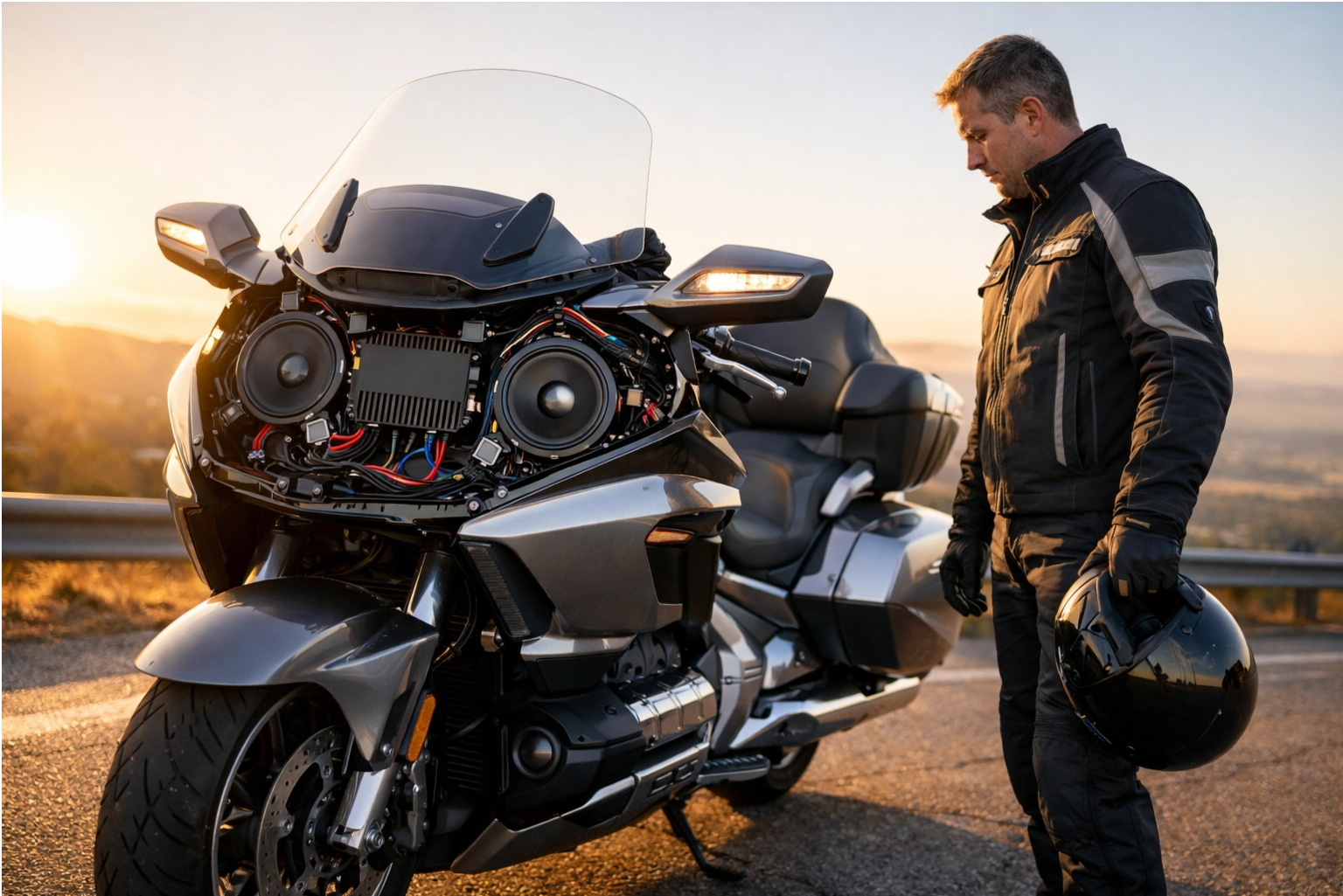
There is the rumble of the engine, the whistle of the wind on your helmet, and the rhythmic sound of tires on asphalt which all touring riders are familiar with. However, something changes when the quality of audio is added to this experience. I have ridden cross-country routes for over fifteen years and tried many different audio systems, and I can say that finding the right setup often starts when riders explore the catalog on ShinyWing to compare options suited for long-distance touring. The appropriate sound system doesn’t just make the ride more enjoyable, it reduces fatigue, making those 500-mile days feel far less exhausting.
The History of Motorcycle Audios
Motorcycle audio systems have evolved significantly compared to the small speakers of the past decades that were prone to weather. The current touring audio system provides the quality of concert sound and is capable of resisting the most adverse riding conditions.
The current systems can be easily combined with navigation systems, communication devices, and smartphones to form a full entertainment and information hub in your touring motorcycle.
Why Motorcycle Audio Is Different From Car Audio
The situation is still special unlike in automotive audio. The challenges that motorcycle stereos have to overcome which are not in the case of car stereos are continuous vibration, exposure to entire weather, extreme changes of temperature, and the wind noise at highway speeds.
These considerations require expert engineering and materials that can produce audio quality even when exposed to a situation that would ruin a regular speaker in a few weeks.
Factory Systems and Why Upgrades Still Matter
Integrated audio systems have been set by premium touring motorcycles such as Honda Goldwing. Nevertheless, these advanced factory systems still can utilize a number of advanced upgrades that can help them overcome certain performance constraints or introduce new functionality that riders will find that they require once they have ridden serious miles.
Essential Elements That Superior Touring Audio Requires
The quality of the speakers defines the upper limit of the potential of your audio system. High quality motorcycle speakers are made of marine quality material that is weatherproofed, surrounds are built in UV resistant material, and the cone material is unique and produces clear sound despite vibration at all times.
It is equally important that the physical mounting design is correct, since improper mounting may give rise to rattles and resonance that will invalidate even the best speakers.
Amplification and Clean Power at Highway Speeds
Power of amplification makes the difference between decent audio systems and outstanding audio systems. Most riders do not realize the amount of clean power required to break through the background noise at 70 mph.
Quality amplifiers are designed specifically to drive in motorcycles and actually furnish enough power to drive through the background noise and add in features such as dynamic volume adjustment, which automatically adjusts as your speed changes so that you get consistent listening levels without having to do it by hand.
Modern Source Units and Rider-Friendly Controls
The units of the sources are now technological wonders, providing Bluetooth streaming, Apple CarPlay, and Android Auto integration, and being compatible with satellite radio.
The most desirable units are those that have a combination of a wide range of features and easy-to-use interfaces that riders can use safely without losing their sense of the road. Touchscreens should be gloved-finger responsive, and the layouts of the controls should be designed to be used by muscle memory with no visual input needed.
Finding Niche Solutions for Gold Wing Owners
Honda Goldwing motorcycles are the best in touring luxury, and the audio systems should have components designed exclusively to fit these amazing machines. Examining the catalog on ShinyWing you will see Goldwing audio accessories which have a model specific fitment so that they will fit perfectly with the model and look like they were installed by the factory and yet perform better than the original equipment.
Among the specialized services provided by ShinyWing are replacement speaker sets that can fit directly in factory locations without any additional work, amplifiers that are designed to operate in harmony with Goldwing electrical systems, and high quality wiring solutions that allow the transmission of the signal without any rework and installation is made easy.
The catalog includes upgrades on the helmets, audio controllers on the handlebars, and acoustic improvement materials which make the best use of the sound in the special fairing structure of the Goldwing.
Why Model-Specific Fitment Matters
Model-specific Goldwing audio accessories are not just convenient in terms of fitment. These elements take into consideration the electrical peculiarities of various model years, include mounting solutions that are compatible with existing brackets and fasteners, and provide the acoustic properties adjusted to the specific cabinet volumes and resonance of the Goldwing.
This is extremely uncommon with generic motorcycle audio products.
Use Your Model Year to Narrow the Right Parts
Knowing your model year will help to reduce the number of choices. The Goldwing has developed into several generations, with its electrical architecture, mounting configurations, and factory audio capabilities significantly altered.
Parts that are fitted in newer GL1800 components may not fit older models and expert knowledge is therefore very important when selecting parts.
Installation Insights From Experience
It has been ten years of experience in installation and a few insights on how it works.
Plan the System Before You Touch the Bike
Effective audio upgrades start way before instruments come into contact with the motorcycle. A plan to follow the order of installation, procurement of the required materials, and the architecture of the system you are using will save you the stress of having to realize that you are halfway to finish a project but cannot get the required parts.
I also realized that the hard way when I did my first major audio upgrade that took me three weekends to complete because I did not prepare well.
Build Reliable Electrical Connections
The most typical break area of motorcycle audio systems is electrical connections. All connections are quality crimped, heat-shrink tubing and dielectric grease are used to ensure long-term reliability which cannot be replicated by cheap connectors.
Spending an additional hour in routing and securing all the wiring correctly will help avoid chafing problems that crop up thousands of miles down the line when you are not anywhere near home and straddling audio dropouts.
Test Everything Before Final Assembly
Checking every part prior to final assembling is a massive headache. Troubleshooting can be easily done through confirming that the speaker polarity is correct, that the amplifier output levels are correct, and that all control functions are working properly with everything in the system being accessible.
Tying fairings and finding out during the post that something wrong has happened entails making the same hours of unraveling.
Performance Optimization Through Proper Tuning
Even the best audio parts will not perform to their level best unless they are tuned. The vast majority of riders do not even experiment with the equalizer controls of their system or change the input levels, and they are leaving much of their performance untapped.
An hour of systematic trial and error in these parameters, obtained by riding at different speeds, produces dramatic changes in perceived sound quality.
Helmet Choice Affects Sound
Audio is greatly influenced by helmet selection. Full face helmets form acoustic chambers on which some frequencies are highlighted whilst others are reduced.
Open face designs permit more wind vibration yet offer increased direct speaker acoustics. Such interactions can be used to optimize the settings of the equalizers to suit your particular riding setup.
Match Volume Across Sources
Volume matching on various sources of audio avoids the inconveniences created by sudden change of music to GPS navigation or phone calls.
Many of the current systems would have individual source volume controls that would be able to be set to the same levels and it would not be needed to keep getting them adjusted during a ride.
Maintenance Strategies for Long-Term Performance
After the systematic check-up, minor problems are not given a chance to turn into major problems. Inspections of speaker grills to make sure they are not filled with debris, confirmation that mounting hardware is taut, and inspection of electrical connections against corrosion can be completed in minutes, yet lifetime of components is increased significantly.
Seasonal riders also enjoy the advantage of protection of speakers during storing time to reduce the dust and UV radiation.
Keep Software Updated
Updates on microchips: there are frequent performance enhancements or bug fixes with software updates to advanced head units. Periodic checking of the manufacturer websites and implementing the changes offered ensures that the systems run as they should.
The maintenance procedure is a basic operation that often fixes strange glitches that would otherwise necessitate an unjustified replacement of a component.
FAQ: Touring Audio Upgrades
Can I get good results with speakers only, or do I need an amplifier?
The most common question that is posed by the riders is whether the improvements can be compensated by simple speaker upgrades or amplification upgrades are required.
The truth of the matter is subject to available capabilities and performance expectations of a given system. The weakest part is often the factory speakers, yet no matter how good the replacements are, with poor amplification they will not be able to effectively counter highway wind noise.
Is it okay to mix parts from different manufacturers?
With mixing of parts of different manufacturers, compatibility issues become a problem. Although possible, single source integrated systems generally provide better results due to coordinate tuning and optimized impedance matching.
The process is also user-friendly since the installation can be guided through detailed guidelines applicable in entire system installations.
Will audio upgrades affect my motorcycle warranty?
The warranty issue involves lots of riders who think of aftermarket audio modifications. The majority of manufacturers will not cancel out complete motorcycle warranties on the basis of audio upgrades, but will not cover the damage that can be directly linked to improper installation.
These concerns are reduced by professional installation or obsessive DIY work by best practices.
Are motorcycle audio upgrades truly weather-resistant?
The weather resistance questions are not a rare thing and it fully has the right to exist. High quality motorcycle audio parts have authentic weatherproofing that protects against rain, humidity, and extreme temperatures.
Nevertheless, quality installation to ensure factory weather sealing is essential to ensure prolonged reliability.
Final Thoughts
The only way to turn a sound system in your touring motorcycle into the best system is by knowing how the components interact, what components to use, and how to install them to guarantee success.
No matter whether you are searching the catalog of ShinyWing to find some specific Goldwing audio accessories or are researching what to achieve on other touring platforms, investing in high-quality audio technology is always worth the money over thousands of miles as it makes every ride more pleasant and not so exhausting.
